© 2019 Devon Cattell, Unauthorized use or reproduction prohibited
Capturing the Beauty of
Black Cats
It's not easy to see the beauty of black cats. Ask at any
shelter and they'll tell you they have trouble finding homes for
black cats (and black dogs). Of course there are a few
superstitious nuts, but the main reason people aren't attracted
to black animals is that it's difficult to see their faces and
thus their personalities. It's hard to connect with an
animal when you can't read its face.When you see a black cat right next to a non-black cat you can see why it's more difficult to read the black cat's face:
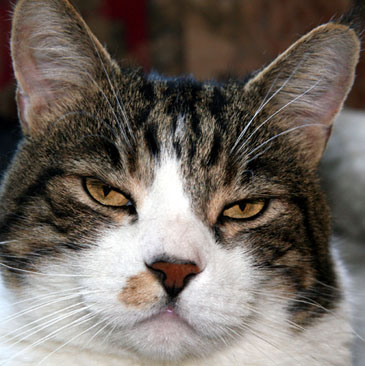
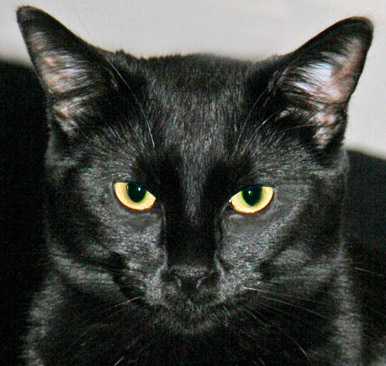
It's the contrasting colors in the
other cat's face that make it easier to see his facial
expression. With the black cat all you can see is sheen.
Here again you can see that the black cat is "faceless" as opposed to the other cat whose thoughts are written all over his face:
Here again you can see that the black cat is "faceless" as opposed to the other cat whose thoughts are written all over his face:
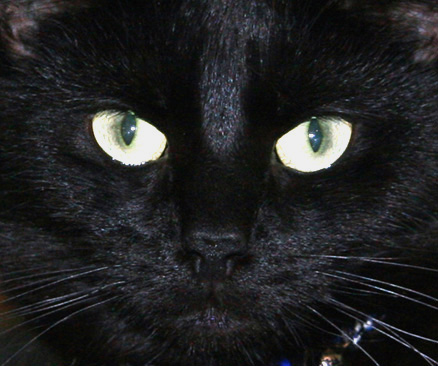
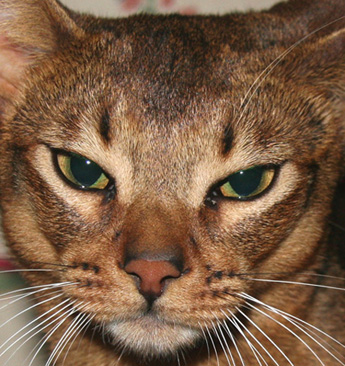
But there are ways to capture the beauty of black cats. You'd think that it would just be a matter of lighting and background, but it's a bit more complicated than that. On this web page I'm going to explain ways to photograph the beauty of black.
Contents
The Background
Keep the Background Free of Clutter
Controlling the Background
Avoid Too Much Contrast
Finding Background Colors That Enhance
Lighting
Mal-face Lighting
Professional Lighting
More Affordable Lighting
Free Lighting
Posing
Bald Spot Angling
Props
Looking where you want them to look
Good Tongue-age
Drop What You're Doing Poses
Photogenic
Summing It Up
Dedication
Lord Byron said it best: She walks in beauty, like the night Of cloudless climes and starry skies, And all that's best of dark and bright Meets in her aspect and her eyes; Thus mellow'd to that tender light Which Heaven to gaudy day denies. One shade the more, one ray the less, Had half impair'd the nameless grace Which waves in every raven tress Or softly lightens o'er her face, Where thoughts serenely sweet express How pure, how dear their dwelling-place. And on that cheek and o'er that brow So soft, so calm, yet eloquent, The smiles that win, the tints that glow, But tell of days in goodness spent; A mind at peace with all below, A heart whose love is innocent. |
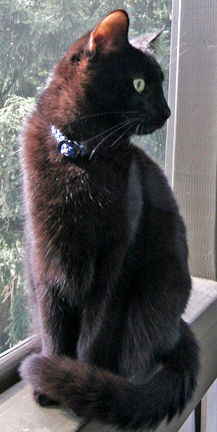 April/2006 -
October/2007
|
The Background
People tend to ignore the background when they take pictures, but it makes all the difference when photographing black animals.
~~~~~~~~~~~~~~~~~~~~~~~~~~~~~~~~~~
Keep the Background Free of Clutter
~~~~~~~~~~~~~~~~~~~~~~~~~~~~~~~~~~
Keep the Background Free of Clutter
~~~~~~~~~~~~~~~~~~~~~~~~~~~~~~~~~~
If you plan a photo-shoot it's best to choose an area that's free of clutter. Clutter distracts you from the subject (the cat).
With unplanned photo-shoots though, you sometimes can't avoid clutter. This can be fixed with a bit of cropping, for example, here is Vinny with his toys:
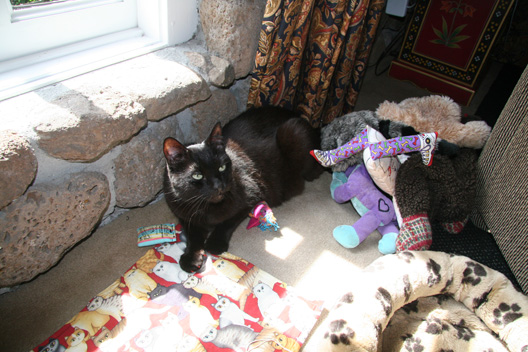
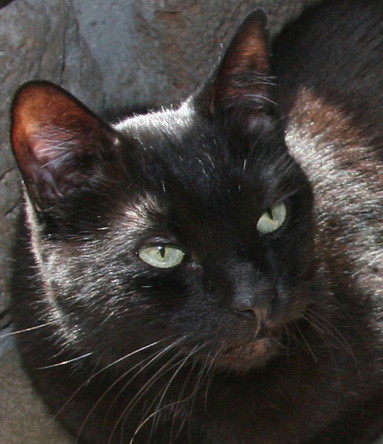
But you can see his beauty much better when you crop away the clutter - look at that handsome face and healthy fur sheen:
~~~~~~~~~~~~~~~~~~~~~~~~~~~~~~~~~~~~~~~~
Controlling the Background
~~~~~~~~~~~~~~~~~~~~~~~~~~~~~~~~~~~~~~~~
Controlling the Background
~~~~~~~~~~~~~~~~~~~~~~~~~~~~~~~~~~~~~~~~
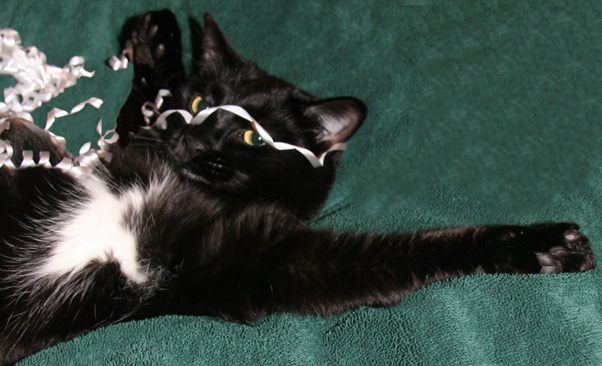
The easiest way to control the background is to take a blanket or sheet or towel, and drape it over a chair, or over a bed and its headboard. This puts the background color below and behind the cat so that you can take pics from any angle without having any uncomplimentary colors in view.
~~~~~~~~~~~~~~~~~~~~~~~~~~~~~~~~~~~~~~~~
Avoid Too Much Contrast
~~~~~~~~~~~~~~~~~~~~~~~~~~~~~~~~~~~~~~~~
Avoid Too Much Contrast
~~~~~~~~~~~~~~~~~~~~~~~~~~~~~~~~~~~~~~~~
A common misconception is that it's best to use a
background that contrasts with the black cat, like
white. Although it's easier to see contrasting
colors in real life, it doesn't work at all when
photographing black animals.
Too much contrast is hard on *your* eyes (ask your ophthalmologist), makes it hard to see *the cat's* eyes and fur-sheen, and makes the cat appear to have no mouth at all:
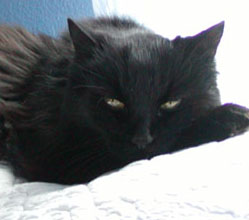
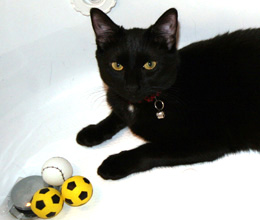
Too much contrast makes
it difficult for the auto-exposure and auto-focus on your
camera to work properly. You always end up
with fuzzy focus and eye-boggling contrast.
If you have complete lighting control and can get a perfect soft light you can use some light colors instead of the rich colors, but it's easier if you keep it simple at first.
Too much contrast is hard on *your* eyes (ask your ophthalmologist), makes it hard to see *the cat's* eyes and fur-sheen, and makes the cat appear to have no mouth at all:
If you have complete lighting control and can get a perfect soft light you can use some light colors instead of the rich colors, but it's easier if you keep it simple at first.
~~~~~~~~~~~~~~~~~~~~~~~~~~~~~~~~~~~~~~~~
Finding Background Colors That Enhance
~~~~~~~~~~~~~~~~~~~~~~~~~~~~~~~~~~~~~~~~
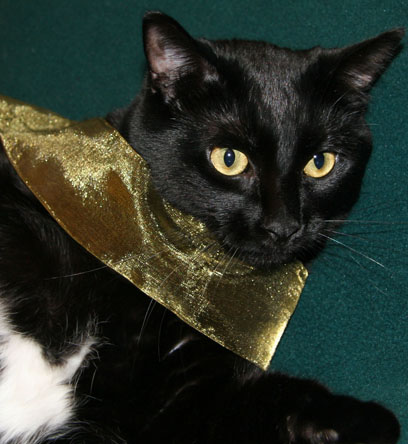
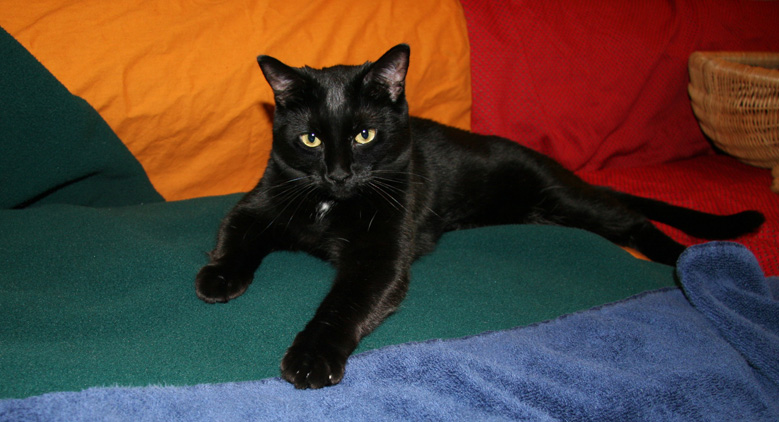
The first priority in seeing a black cat's beauty is to accentuate its eyes. Black cats' eyes are in the green to yellow to copper range. I find that medium dark-green and deep gold work well to bring out the color of yellow-eyed cats. Here the green doesn't contrast too much with her fur and the gold brings out her eyes:
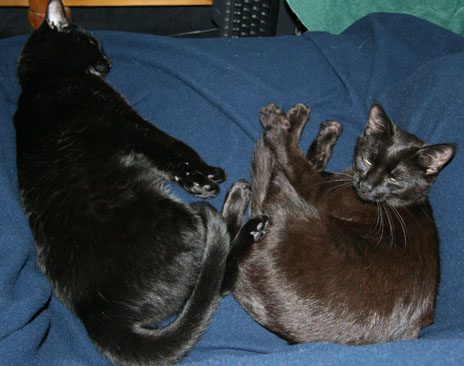
Another consideration in choosing a background color that appeals is that in reality, "black" cats are usually not truly black, but rather very dark brown. Think about colors that look good with brown like green and red. Here we have the unusual almost truly black cat on the left and the normal deep-chocolate "black cat" on the right:
Mixed rich colors are nice:
 |
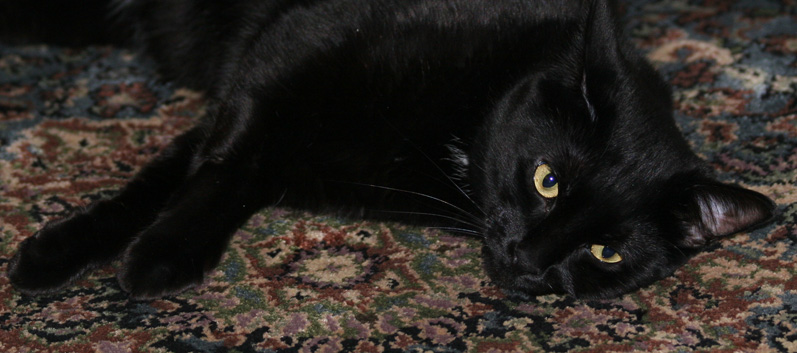
Black on black usually works well too, and from a practical point of view, I highly recommend black furniture and carpets - it cuts down on having to clean up the fur and you don't have to worry about stains - you can spill red wine on them and you don't even have to clean it up: |
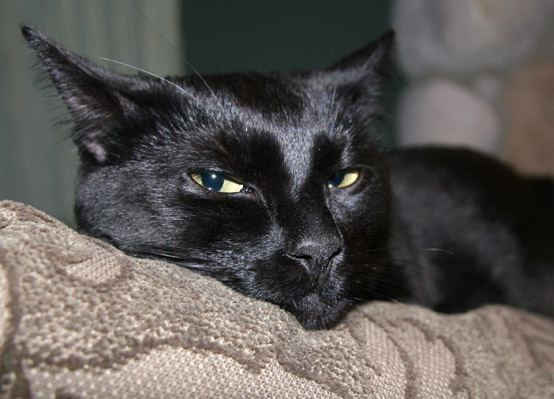
Medium brown works well:
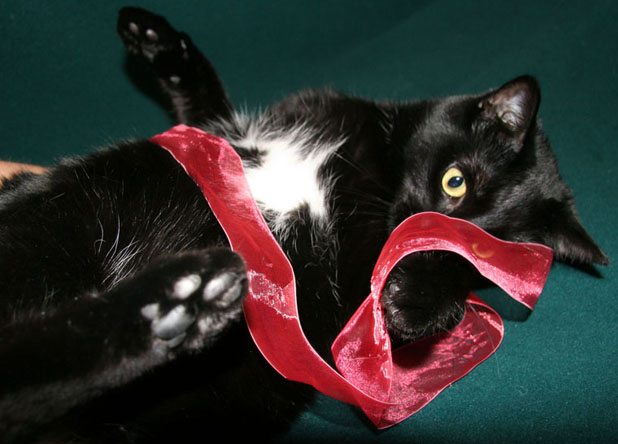
But in my opinion, the deep greens are best:
Experiment with your cat with different background colors. Each black cat is a slightly different shade of black, so different colors enhance their beauty. Try towels and sheets and blankets and tablecloths and large scarves and if you're willing to go to a fabric store, you can choose even more colors at reasonable prices. Throw them over the bed and experiment!
Lighting
~~~~~~~~~~~~~~~~~~
Mal-face
lighting
~~~~~~~~~~~~~~~~~~
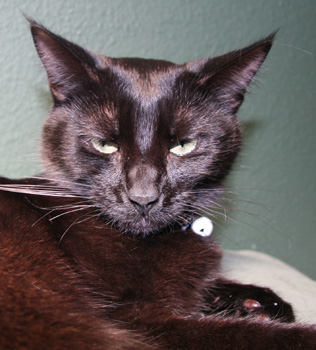
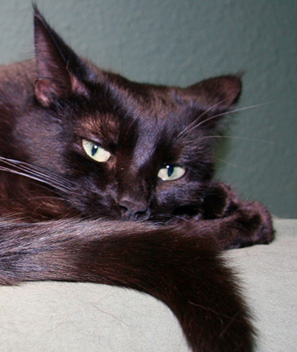
With black cats, depending on the direction in which the cat's fur lies, light reflects off of it to create bizarre shapes making faces look malformed. I call this mal-face lighting. The way to avoid this is to use a soft light, preferably indirect sunlight.
Below see two pictures of the same cat, with the same background, but the lighting on the right is less harsh, natural indirect sunlight, at the right time of day. See how the harsh light makes her face look malformed?
And here's a a serious case of mal-face:
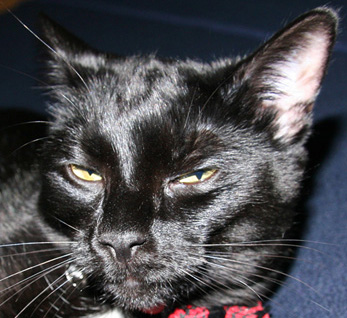
But the same cat looks beautiful with soft lighting and colors that enhance her fur and eye colors:
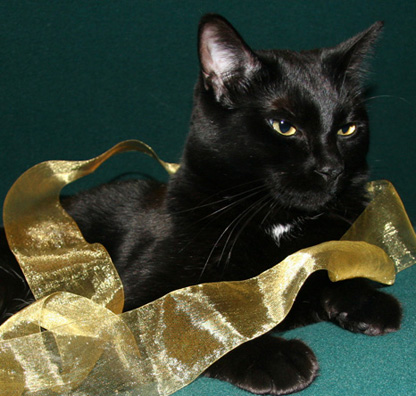
Sometimes the mal-face can add a humoristic character to the photo:
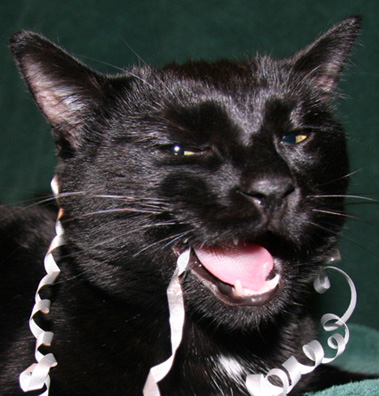
I know it looks like she's eating the ribbon in
this pic, but really she just
has the end in her mouth. I took it from her before she could ingest any.
has the end in her mouth. I took it from her before she could ingest any.
~~~~~~~~~~~~~~~~~~~~~
Professional Lighting
~~~~~~~~~~~~~~~~~~~~~
Professional Lighting
~~~~~~~~~~~~~~~~~~~~~
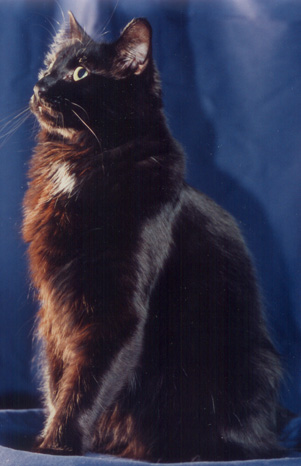 |
If you want to spend the
kind of money that professionals do for perfectly
controlled lighting, you can get this effect with lights
pointed away from the cat at silver umbrellas which
reflect a softer light back on the cat. This is an old "film" pic but you can still see how the softer light makes him look softer. Even the blue background, which is just a plain cotton sheet, looks softer. He also has excellent fur sheen in this picture. Good sheen gives him that silky coat look - so handsome! |
~~~~~~~~~~~~~~~~~~~~~
More Affordable Lighting
~~~~~~~~~~~~~~~~~~~~~
More Affordable Lighting
~~~~~~~~~~~~~~~~~~~~~
It's best to have the light coming from several sources: a few lights and maybe the flash from your camera. This soft-light-from-all-sides method reduces the "flat" look that a harsh light gives.
Another way to provide light that isn't harsh is to reflect a bright light off of a white surface, like a sheet or poster board or a white wall. This is the same idea as the fancy silver umbrellas that the professionals use, but much less costly. Keep in mind that the white surface should not be *in* the picture or you get the too much contrast problem.
Good lighting also helps reduce the red-eye problem (actually on a cat it's usually yellow-eye but you know what I mean). The idea with black animals is always soft light makes soft-appearing fur and minimal mal-face.
~~~~~~~~~~~~~~~~~~~~~
Free Lighting
~~~~~~~~~~~~~~~~~~~~~
Free Lighting
~~~~~~~~~~~~~~~~~~~~~
Then of course there's free lighting - sunlight. It's best when it's fairly bright but not direct sunlight. Sometimes you can get this effect out of doors on a cloudy day or in the shade, making sure that there isn't any unshaded sunlight in the background to upset your camera's exposure settings. Alternatively, look at how the sunlight comes into the rooms in your home throughout the day and find a room where you can get clear indirect sunlight. Note what time of day it is when the lighting is best and plan to take pics at that time. To get the right lighting, *when* is just as important as *where*. Here we have very soft indirect sunlight on a screened in patio:
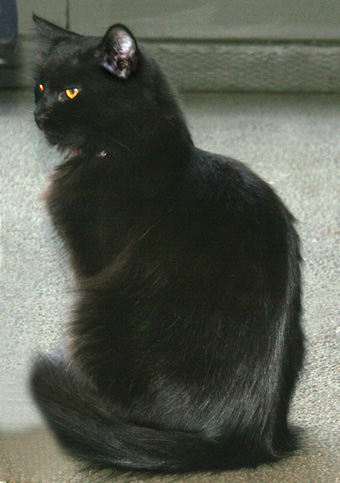 |
See how his sheen is soft and rounded, not giving the harsh, flat, planes of bright mal-face lighting. |
Always remember the most important point when dealing with light is that you don't want it to be behind the cat or there's too much contrast. Take the photo with your back to the sun, otherwise the exposure settings run amuck.
Posing
~~~~~~~~~~~~~~~
Bald Spot Angling
~~~~~~~~~~~~~~~
Bald Spot Angling
~~~~~~~~~~~~~~~
Another thing that makes photographing black cats difficult is the bald spots. The places where a cat's fur is sparse really show up on black cats because the white skin contrasts so much with the black fur. Their fur is slightly sparse on their lips and chins, and they're practically bald on their temples. This space between their eyes and ears is where they have scent glands with which they mark you when they rub their temples against you. As if the contrasting white skin there weren't bad enough, many black cats have tabby markings (stripes) on their skin which you can only see through these bald spots. Note in this pic Nefret has orange tabby stripes on her skin over her eyebrows:
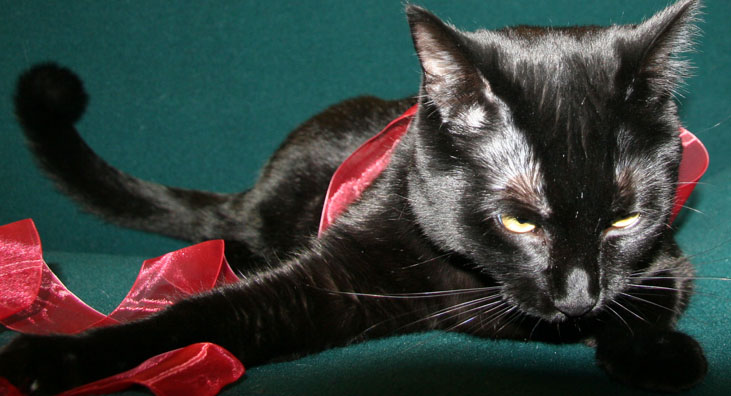
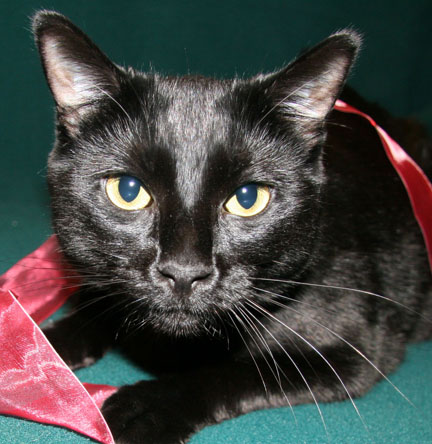
You can avoid these bald spots showing up if you take the pic at the right angle, not looking directly at the top of her head, but rather having her nose up higher. Generally the rule is that if you can see the front of her nose then the angle is good for not showing the temple bald spots:
Alternatively, you can Photoshop them out. This shot has both harsh lighting and bad angles so you see her bald temple spots and she appears to have baggy eyes. Luckily it's not too difficult to Photoshop these out with black cats (not nearly as difficult as Photoshopping out *my* wrinkles...).
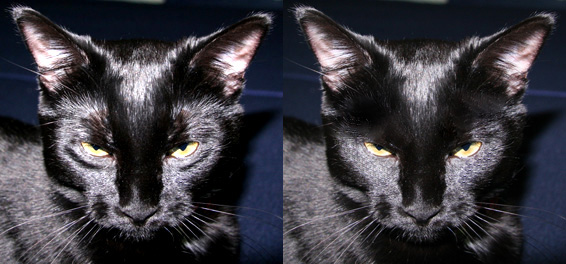
| In the pic on the left her baggy eyes make her look like she's hung over and her skin markings on her temples look like little devil-horns about to come in | On the right, she just looks miffed (she really hates that flash, and one day, when I least suspect it, she's gonna kill it). This is a nice Halloween shot. |
~~~~~~~~~~~~~~~~
Props
~~~~~~~~~~~~~~~~
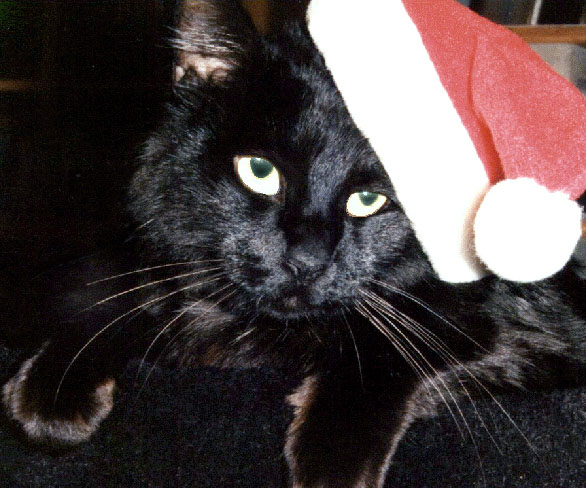
Photos are also enhanced when the cat's personality shows through. Generally, torturous props don't add to the cat's cheery disposition, though they can be comical:
A ribbon is a much better prop because the cat enjoys playing with it, but you have to be darn sure she doesn't eat it. Ribbons can get into the digestive tract and do really nasty things there. Here, she looks like a ham, but she's really only just trying, unsuccessfully, to eat the ribbon:
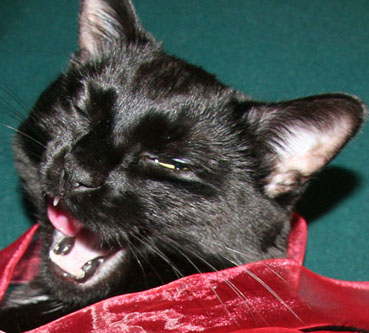
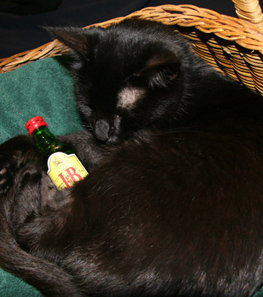
Use your imagination and you will find many little non-dangerous props around the house. One very fashionable prop is a toy mouse placed on kitty's head or post-it notes placed any old where. If you're too cool to do something that's already been done (over and over again, so help me if I see another mouse-on-head pic I'm gonna puke), just look for small things that your cat can't swallow and hurt herself with like this little Scotch bottle that I stuck in her paws while she was trying to sleep:
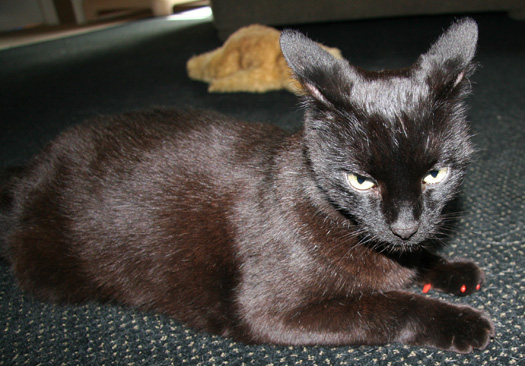
Here I was trying to do a prop-shot with Mr. Teddy bear and as I was giving up on Vinny staying-put-with-the-prop, he suddenly did his bunny imitation and I was ready:
Here are a few prop suggestions to get you thinking:
Glass of Champagne
Teddy Bear
Hats
Chess set
Cooking pot
Plant pot
Basket
Eye glasses
Book
Cigar
Toothbrush
Food (cereal box, fruits, milk carton,...)
Salad bowl (with cat in bowl)
You can also combine background drops with props, for example you can put a towel in the basket, or wrap a scarf around part of kitty's body.
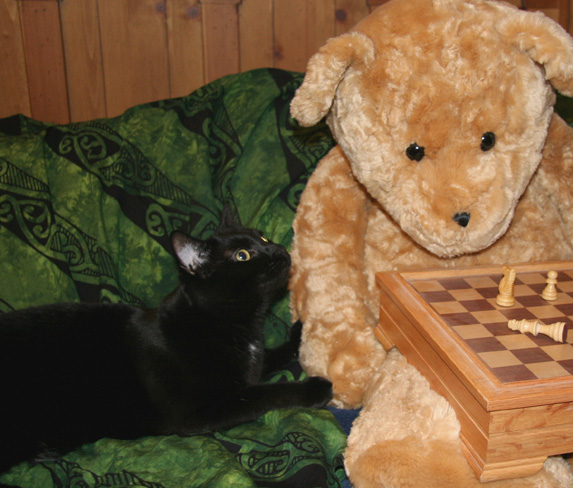 |
Keep in mind that
as with the background, you don't want the
prop to contrast too much with black or your
exposure will be whacky like this Teddy that was
too big and just a little too light in color
(besides, I think he was cheating at chess).
Because of this contrast you can't see the cat's
fur sheen clearly and the auto-focus doesn't work
properly either. If there isn't too much contrast elsewhere in the photo, you can toke up the contrast to see the fur sheen later with Photoshop. But if there's something too light in the pic then it will look radioactive when you increase the contrast. |
~~~~~~~~~~~~~~~~~~~~~~~~~~~~~~~~
Looking
where you want them to look
~~~~~~~~~~~~~~~~~~~~~~~~~~~~~~~~
~~~~~~~~~~~~~~~~~~~~~~~~~~~~~~~~
Controlling their gaze is also important for bald spot angling, and for creating a personality shot like this "look left" shot which allows you to put a photo beside it and make any comment you want:
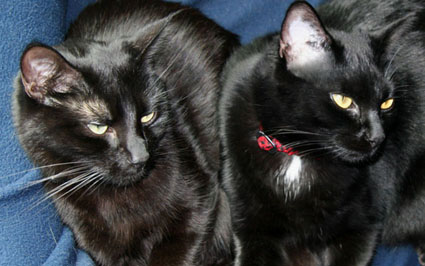
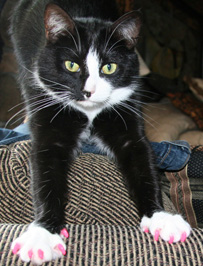
| Bastet: Mama's
showing off her new manicure. Nefret: I don't think pink is her color. |
Mama: They are soooo catty. |
Most animal photographers tell you to come down to the level of the animal for better shots. Like all great truths, this is true, but not always. Angle is very important. As I said before, you want the front of the cat's nose to be visible if you don't want to see the bald temples, but you can do this and be slightly higher than the cat. This gives you sweet "looking up at you" eyes:
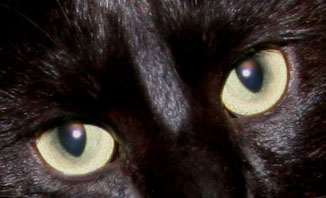
Here's my little Sweetheart who
I lost in October/2007 to FIP
: - (
It's taken from this cat-in-drawer pic which I thought was going to be a nice personality shot, but I found that it wasn't quite as nice - too much clutter. But cropped it's a great eyes-pic.
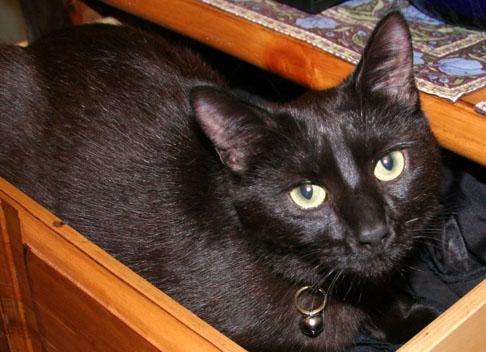
Of course it's not as simple as just getting her to look at you, sometimes it's *how* she looks at you. Here are shots of the same sweet cat above but with different lighting and different moods:
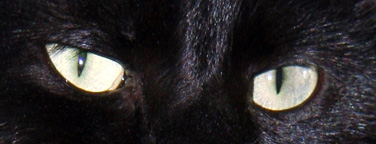
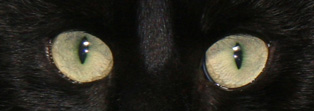
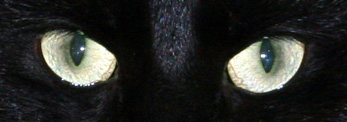
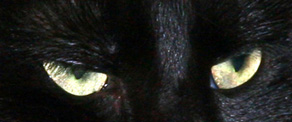
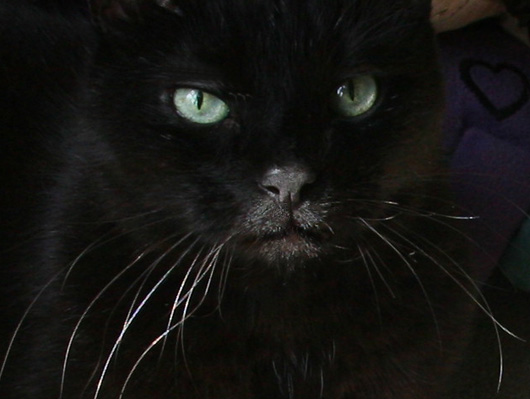 |
Lighting also can help make their eyes stand out. In this low lighting shot Vinny has just enough light to bring out his eyes and a dapple of sunlight is playfully kissing his lips. You can't see any fur sheen because of the minimal light, but his eyes stand out as mysterious windows to his mind and his hilighted whiskers add balance and catly dignity. |
~~~~~~~~~~~~~~~~~
Good
Tongue-age
~~~~~~~~~~~~~~~~~
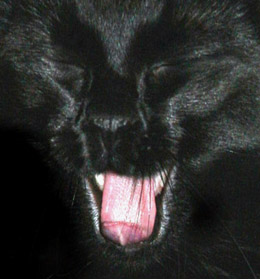
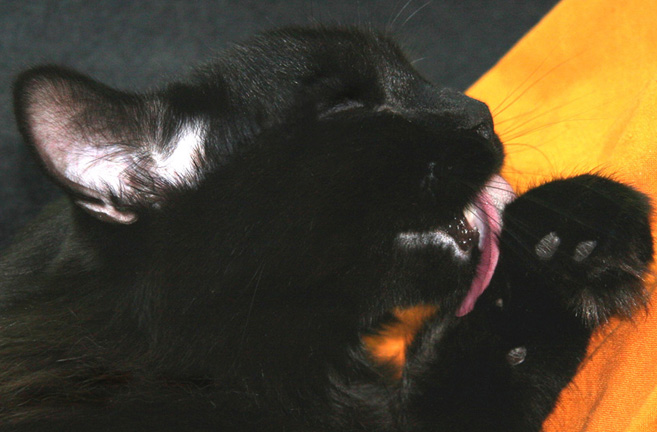
Tongue shots, which I call "good tongue-age," show off the second most visible part of a black cat's face (after its eyes). Just follow them right after they eat and take rapid photos - they *will* lick themselves. And don't forget backgrounds - you can pick them up right after they eat and set them on the bed or chair with the background sheets/blankets ready to compliment their eyes. Alternatively with a tongue-age pic you can completely cut out the background and just go for the face:
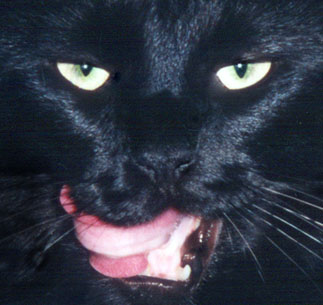
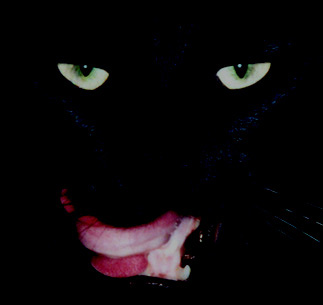
Here, a tongue-age shot taken right after eating makes her appear to be sticking out her tongue:
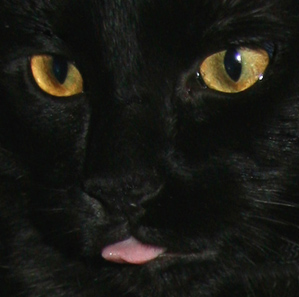
I keep a few of these around for every occasion:
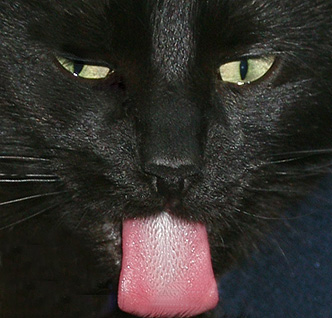
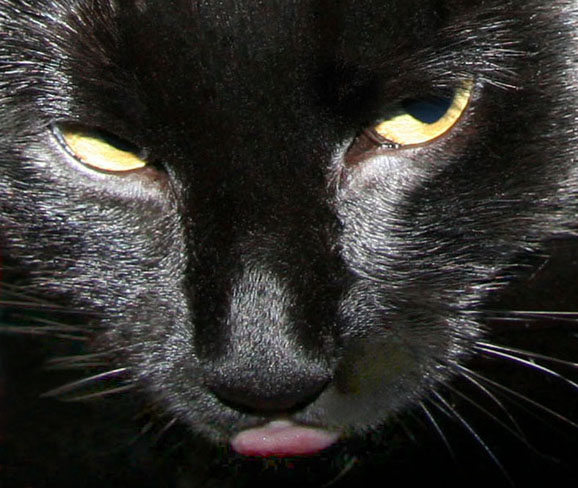
Another opportunity for good tongue-age is just after they wake up. I found these two sleeping and I grabbed my camera and ran back to them and sure enough they woke up and did what cats do when they wake up - yawn, several times. They have a pretty good background (the green matches one of the cats' eyes) and excellent tongue-age:
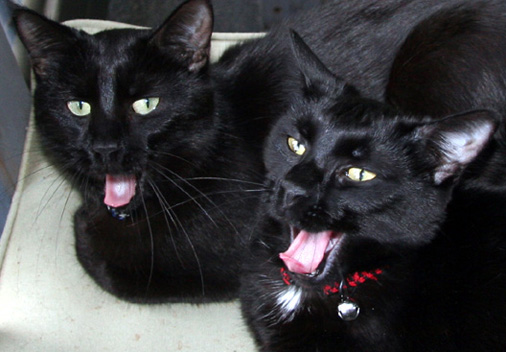
Please note that the only reason that the contrasting background colors work here is that the lighting happened to be perfect - indirect sunlight, filtered through the screened-windows in the patio.
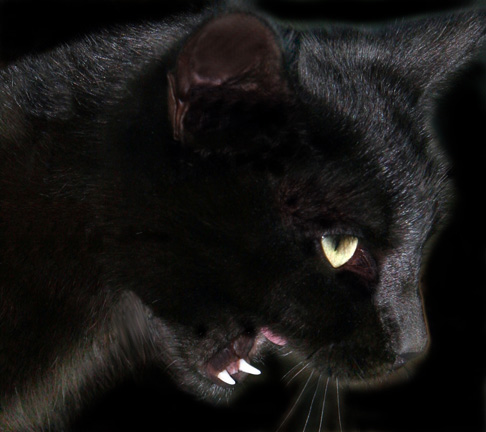
Here's kitty mid-yawn, which makes her look like a vampire kitty. Perfect for Halloween cards, or threats; I gave this one to my vet with the caption - "You want a blood sample? I do not *give* blood! I *take* blood!"
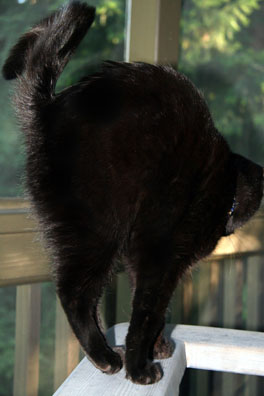 |
Another good Halloween shot that you can sometimes catch right after they wake up is the Halloween cat stretch. |
And here's "Don't
make me laugh!"
~~~~~~~~~~~~~~~~~~~~~~~~~
Drop What You're Doing Poses~~~~~~~~~~~~~~~~~~~~~~~~~
Unlike good tongue-age shots which can be planned for after they're eating or when you wake them, most good poses just happen and you have to be willing to drop what you're doing, grab the camera and shoot.
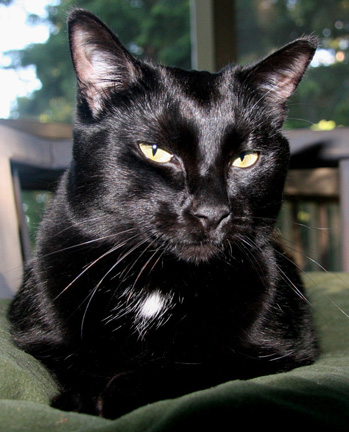 |
Here the lighting was perfect so I grabbed my camera. She crossed her legs in a casual pose and I was ready. Nice sheen. She looks like she's ready for a good gossip. |
The sleeping-kitty look is charming. It's best if you can get them to sleep on a chair (for good below and behind background color) or on a bed. If you put the chair in front of a window they usually like to sit on it and to look out the window and then end up sleeping there giving you natural light (indirect or late afternoon sunlight is better than direct midday sun - less mal-face). Just keep the camera near the chair and go about doing your domestic chores and as soon as they're bored they'll curl up and go to sleep and you'll have the camera ready to grab and shoot.
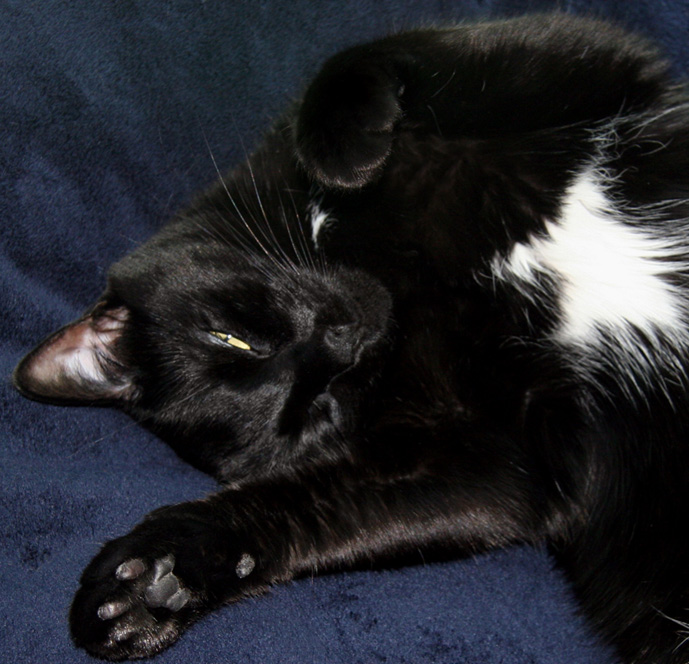
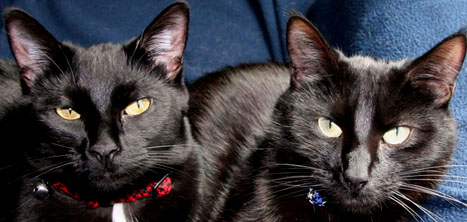
When I found these two asleep on their chair by the window, I ran to get my camera and woke them up and they gave me a nice eye-contact pic:
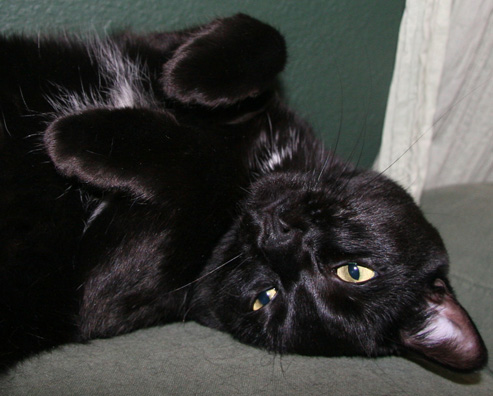
The one-eared cat (i.e. I wanna play) is my favorite pose:
Cat's really do like to show off for you. For example they like to show off their prowess when they scratch on the scratching post, which is why cats don't use the scratching posts that you stick out in the garage. They want to show off where you hang out the most, be it your TV room or by the computer or the bedroom. I keep a cat fishing-pole-toy near where I sit to watch TV and play with the cats at this time so for me, this is "The Location." Figure out where you give your cats their quality time and keep your camera right there because by the time you go to another room to get your camera, the incredible cuteliness will be history.
I used to think that "photogenic" meant good looking. I've recently come to see this is not at all true. I suppose that's why the film industry spends so much time and money on screen testing. I didn't truly believe it until I noticed that one of my brothers, who is very handsome in person, is not at all attractive in pictures. Conversely, one of my neighbor's cats, Rumpy, who is not very exceptional in "person," is adorable in photos:
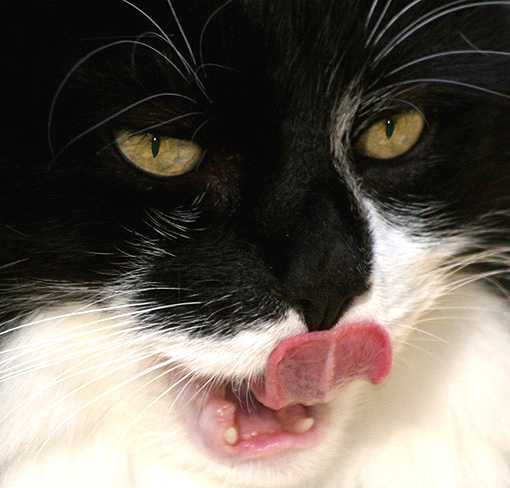
Being photogenic is all about looking good flat, i.e. at any *one* angle. Animals/people who aren't normally photogenic can look good if you get them at just the right angle for their "beauty" and with the right lighting (and of course background). With black cats this is extra tricky because you also have to get an angle which avoids the temple-bald-spot problem.
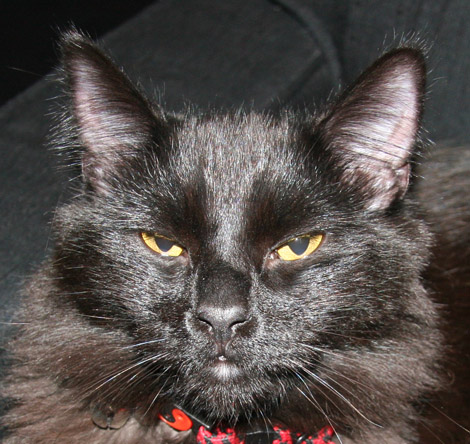
Ramses is a sweetheart but not at all photogenic:
 |
To get good pics of a
non-photogenic cat, first take a photo and take a good
hard look at it, not
the real live animal. Try to analyze
what gives him/her a case of the uglies. With Ramses, it's a mixture of: Fur color: his fur color is not consistent Eyes: he's got odd eyes. He usually opens one eye more than the other, they're slightly crossed, and they're slanted at an odd angle Chin: he has a bald spot on his chin and, Fur scruffiness: like many long-hairs, he's not good at grooming his ruff (mane) so it looks scruffy (Hey - he's just a kitten!). |
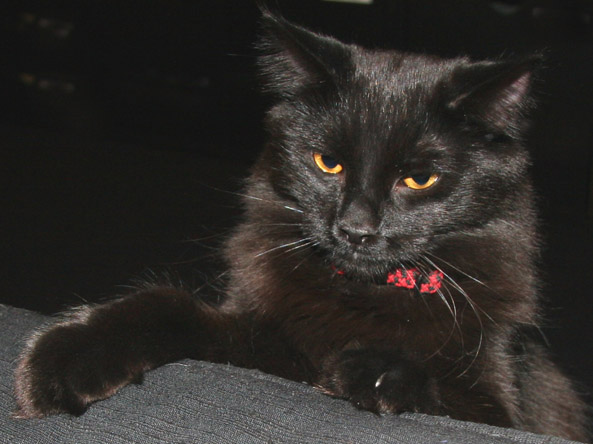
Many black cats have inconsistent fur color. This can be made to look even worse when adjacent colors reflect off of the fur as with the red collar above. To make his color look consistent he needs to lose the red collar. Alternatively, if you want to bring out the red-brown in a black cat, you can use lots of red in the background, but putting it in one place, as with this collar, makes him look brown in just that place. Softer light, the cure for all evils, will also lessen the fur color inconsistency.
Then there are his eyes. Here are some ways to deal with odd eyes.
You can use a profile:
or a semi-profile:
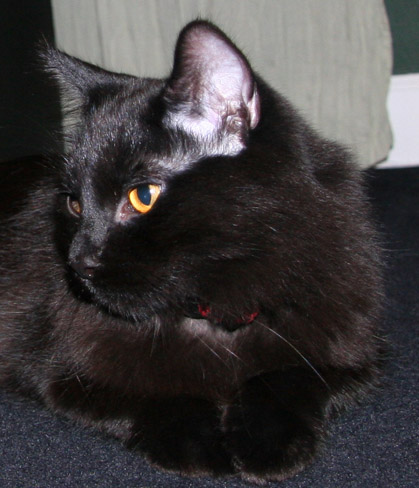
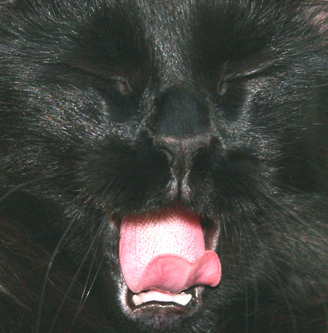 |
Closed eyes works. Here he is singing: "Some - where over the rainbow!" off key, as usual. ; - ) |
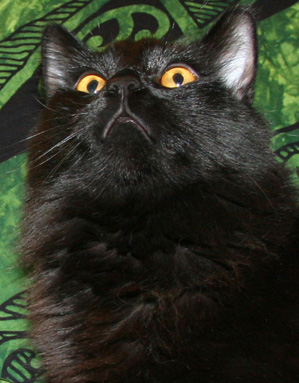 |
or looking up. Here he's pretending there's a spider above my head, but when I looked he said "Hah! Hah! Made you look!" He always gets me with that one! The slight chin angle gets rid of the bald chin look and the odd-eyes and also shows the importance of the old photographers' adage: When you think you've got a good photo, take several more. A small movement of his chin can change his look from average to interesting. |
The only way I've found to get angle-eyed cats to look good and still have eye contact with you is with a slightly tilted head:
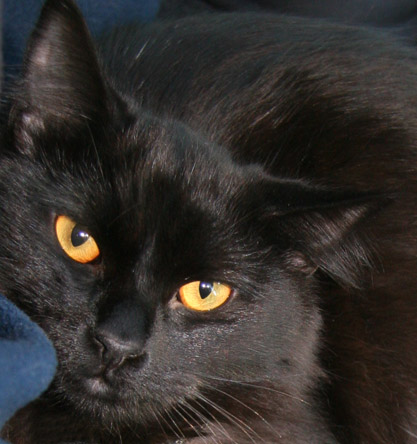
With most long haired cats, you need to brush them before taking pics unless they're extremely good at grooming themselves. If you don't, they just look ratty especially around their necks. After all, it's not easy to lick your neck - you try it sometime... If you do this daily it will cut down on hairballs and fur on your furniture and it's a bonding experience with your cat. If the cat isn't keen on it at first, give him a treat before and after each brushing session. Start out doing just a little bit each day (1 minute) and work your way up to about a 15 minute session. It doesn't take long for them to associate the brushing with the treat and they will actually come to the point of asking you for a brushing. If they don't seem to like it, you're probably brushing too hard. Try brushing your arm with the brush to test what feels good and what feels like torture. Don't try to be totally thorough at first, and avoid areas where they are sensitive like the tail and tummy regions.
Another way to deal with long
haired cats with unkempt fur is to use a soft focus:
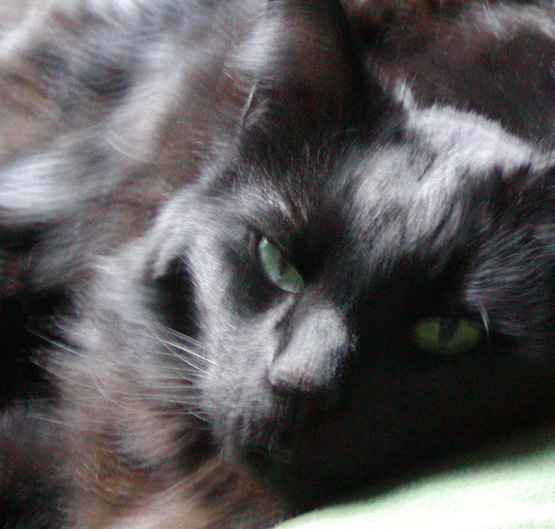

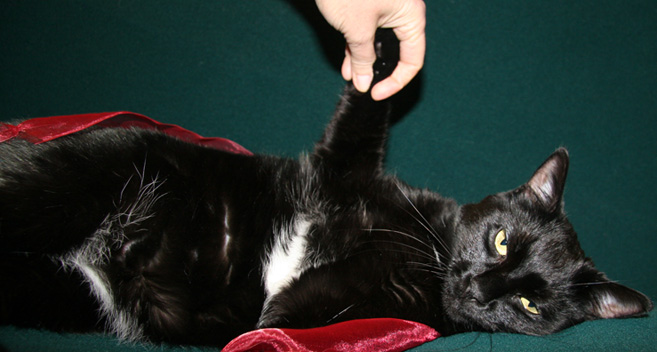
To make your cat look photogenic you always have to look for the beautiful parts and the less becoming parts and then accentuate the positive making them dominate the picture. Here you can see that Nefret has a bit of a waistline problem, but her facial expression is priceless:
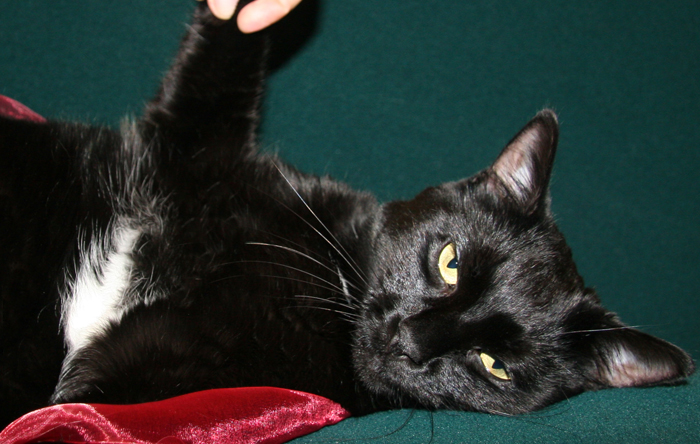
So we crop off the bad bits making the good bits dominate:
Now you've got the tools. Accentuate the positive: eyes, tongue, fur sheen, and personality. Try to catch them waking up or after eating. Find a soft indirect light and minimize bits of bright light and contrasting objects which will make fur sheen less visible. When you think you've got a good picture, take five more, because you never know when just a slight difference in the angle can get rid of those darn bald temple spots. Throw down a few towels and sheets on the sofas and beds, tantalize with some colorful ribbons. Capture the beauty of black and remember "all that's best of dark and bright meets in her aspect and her eyes."
My special thanks to my sweet cat models:
(In alpha order)
Bastet
Buster
Mycroft
Nefret
Niles
Princess
Ramses
Rumpy
Sherlock
Vinny
Buster
Mycroft
Nefret
Niles
Princess
Ramses
Rumpy
Sherlock
Vinny
 Click here if you want to
email me.
Click here if you want to
email me. Back to my home page